Monday, January 8, 2018

Outdoors Winter Shelter

Snow Fort in the Woods

Materials:
Snow
Small buckets
Shovel
Sticks
Plastic lined table cloth


Creation:
For this assignment I went out into my backyard and looked for a place to build a shelter. The first spot that I chose Did not have much to work with so I eventually settled on a low tree branch surrounded by some tall grasses. I first tied the corners of my piece of plastic onto the tree branch. I buried the other end of the plastic in snow. I used some buckets to make "bricks" of snow that I stacked up along the back and side. The snow was very dry and kept falling over on the wall side so I used sticks to complete that wall.

Ideally I would've used enough sticks to completely cover that side, but I did not want to kill too many plants. For the floor I used dried leaves to keep out the moisture from the snow. This shelter is only 1/4 of the size that I would have liked to have made it, but the plastic that I had was not big enough to make it full sized. I could just about fit my whole body inside if I laid sideways, but it definitely would not fit 2 people. The wind was very strong outside but the shelter's location in the woods as well as protection along the windiest sides made it pretty well protected from the outside elements.


The introduction of Eskimo

The first thing comes up to people's mind about Eskimo is their ice house. The stable house which made of ice gave the people a warm place to live. If you haven't seen an ice house, it just looks like that.

Very impressive, isn't it?
Today, it is our honor to invite two native Eskimos to Rhode Island for showing us how to make an ice house.
Right now, let us introduce our valued guests; both of them have a traditional Eskimo name -- Yufan, Yuhang.
Rhode Island recently had a big storm, so we got a lot of material that we need.
Here is the material they need: 1.5 pair of gloves(Yuhang lost one), a shovel, and snow.
Firstly, Yufan and Yuhang choose a stable snow pile which won't collapse while they build a snow house.
Secondly, both of them use their own efforts to dig a hole in the snow pile. It sounds easy, but as Yuhang says it took him 2 years to learn the skill of digging a hole. "you need to make sure you have a small entrance but a big space inside." said by Yufan.

Yuhang is digging the hole.
What is the house looks like at the end?


Yuhang is enjoying his new warm house in Rhode Island.

The Official Snow Hole of Democratic People's Republic of Korea

The two elite engineers of North Korea, Yufan and Yuhang were given the order of building a strategically important fortress in the United States. Due to the party's current shortage of resources, they were given no materials aid. However, they have something that is stronger than any steel-- their unshakable faith in the supreme leader. So they worked hard, from dawn to dusk and behold! the majestic ice castle!
In reality though
This engineering feat may appear to be small but its inside is actually quite large. Its inner volume is about 1.5*1.5*1 meter^3. You can absolutely fit one person in and uncomfortably fit in another one. We used 
  • snow and ice
  • a sheet of paper as floor(due to the lack of plastic)
  • spegaties (as we know are completely natural)

(in construction)
(in construction)
(Inside)
Look, I know this is not much especially when comparing to the other shelters but come on guys, the snow is basically ice at this point and all we had were bear hands and a brush. And isn't the journey that mattered and not the destination? While constructing this shelter, we have found something that is much more important--friendship. In the end, both Jimmy and I have found out that, the real shelter was inside our hearts all along.
-The End-


Sunday, January 7, 2018

Igloo Shelter

When tasked with building a shelter using only natural materials, my initial thinking was a snow fort (especially with the impending blizzard.  However, my concern was that the snow would be too powdery to make a snow fort of some sort.

After spending the first day out in the storm shoveling, I decided to test out the snow on Friday.  Much to my excitement, it was not too powdery and was igloo-ready.  My friend Erin contacted me about making an igloo per our annual tradition, and the opportunity seemed perfect for fulfilling both the tradition and the physics blog!

Overhead view of igloo
Materials
  • Snow shovels (1 small, 1 large)
  • Snow (lots of it)
  • Sheet of plastic (I didn't have one, but one could easily be added as a floor or door covering)

ProcessWe chose to build the igloo in Erin's backyard, as the wind had created a large snow drift (I meant to take a before picture, but I forgot).  From there, we moved more snow onto the drift, and then we began carving out the igloo.  The door location was chosen in the opposite direction of the wind to avoid heavy gusts inside.
The first entrance created into the igloo.
We created a small area inside, and then created our first tunnel, since the snow drift naturally made one easy.  We each worked from both ends and met in the middle.  The tunnel is about 10 feet long and tall enough to crawl comfortably inside it.  We also expanded the area near the entrance to be a larger room where you can sit upright easily.
Tunnel 1
After a quick break, we further expanded the main room and created the second tunnel, which extends in a different direction.  This was not that hard as well thanks to a snow drift formed there.
Tunnel 2
By that time, it was too cold and too late to do anything more, and we were both satisfied with the igloo.  A sheet of plastic could be added to block a door or line the floor, however it felt warm when working inside the igloo, and the wind did not get to us.

Me inside the main area of the igloo


Video


Snow Shelter


Almost every year my brothers and I build a snow fort when we have a snow day. After receiving this assignment, I was so excited that our snow-building skills would be coming in handy!  

Materials:
  • Two shovels
  • Sticks and tree branches
  • Lots of snow!

Construction:

Since I live in an apartment, there wasn’t really a good place to build a shelter near me. So after enlisting the help of my brother Rob, we went to my aunt's house to build the shelter. We found a large snow bank at the top of her driveway that was composed of snow that had been pushed up by a plow, and decided to use this as a base for the shelter.  We started by digging a cave on one side of the snow bank.  Once we got fairly deep, I went to the other side and dug a cave where the exit would be, while Rob continued on the first entrance.  We switched sides several times, going back and forth between them until we broke through and met in the middle. After that, all that was left was to make the space bigger and cleaner.  We dug a path around the outside so both entrances could be reached easily without having to go through the cave every time.  We also found sticks by a cluster of trees near her house and used these to add a little decoration to the cave.  If I had had a tarp, I would have used it to create a floor for the shelter and pinned it up on either end to cover the openings.  However, even without this tarp, the shelter was fairly warm on the inside and did a good job of keeping out the wind.  It was big enough to fit both myself and my brother, and probably could have fit another person as well.  We really had fun building it and I was impressed to see what could be done with just snow!

Final Product:

A tour of the shelter.

A closer look at the inside of the shelter.

Rob and I in the shelter.


Snow Fort

A Snow Fort Ready for a Fight
Materials:
Shovel
3 Sticks
10 x 10 foot tarp
A lot of snow

Construction:
Picking a Location:
The first step in any construction project is picking the location. In the case of a snow fort, this location must be one that has plenty of snow in order to create the structure. In addition to this access to snow, it is preferable that the location is on the side of a hill or a spot where a mound of snow has already been built up. This will make it easier to construct since parts of the structure will already be done. 

For my snow fort. I decided to create it on the side of a hill since there were not any large snow piles that I could utilize that were near my house. The hill I chose was backed by a large rock face that I could use as 1 of the 4 sides that I needed to make the structure.

Before:

Building up the Walls:
After deciding on a location, I began building up the three walls I needed to enclose the area. I started by doing a basic layout of the structure without little snow piles. Once the area was marked and I had made a decision on where I wanted the door, I began shaping the piles into walls that I could pile more snow on top of. While the bottoms of the walls did not take much time at all to make, it became exponentially harder as a tried to make them taller. Eventually, I built them up to an adequate height of about 3.5 ft and started mounting the tarp.

Mounting the Tarp:
In order to mount the tarp, I found 3 sticks in the woods that I could use to allow the tarp to sit on in the front of the structure. Then, I tied two corners of the tarp to the trees that were on the top of the rock face so that the tarp would not be blown away by the wind. Next, I placed the tarp over the three sticks, allowing it to fall, covering the rest of the structure. Finally, I took the two remaining corners of the tarp and buried them in the snow to secure the tarp in place.

After:
Outside:
Inside:

Friday, January 5, 2018

Snow Fort "Fun"

A Shelter From the Cold

Julia Pimentel

_______________________________________________________________

Materials:

  1. Snow shovel
  2. 10 x 5 piece of plastic
  3. 18 inch piece of wood
  4. Lots of snow

Construction:


I went outside around 1:00 p.m. so as to expose myself to the "warm" temperature of the day which was a cozy 13℉ . As I looked around my backyard, however, I realized not much natural material was available to me, so I settled for using a piece of plastic. I decided I would drape this plastic over a low hanging branch, using the snow to pack it in and keep it in place.

After battling the wind to get the plastic over the branch, I began to stabilize it by packing snow up on either side of the tarp, curving the snow up and outward from the inside to maximize the interior space. There were also small gaps between the plastic and the tree trunk so I had to pack snow up all the way to the top in these places. I then noticed that the plastic was moving too much in the wind, so I decided to use a small piece of wood to prop it up, once again using the snow to keep the wood and plastic in place. Lastly, I used the remainder of the plastic as flooring.

The majority of this process was devoted to evening out the amount of snow on each side of the plastic sheet so as to maintain sturdiness and balance. I also had to keep readjusting the plastic to give it enough tension to prevent it from flapping around in the wind.

Final Product:


Inside -


Outside -


Additional Comments:


The fort which I constructed is 1 x 1 yd., which is enough for my small self to fit in, but is 1/4 of the size that I would actually like it to be. Also, as you can see, the entrance allows for a lot of exposure to the cold, but if I had had more resources I would have liked to stack branches and pack them in with snow to close some of that gap off. 

Overall, my fort did a good job at keeping out the wind and cold as I was surprisingly comfortable and warm when I went to sit inside of it. I also enjoyed that I could lean against the trunk for support and could see the sky through the clear plastic.


^^ Me being warm in my shelter ^^

Thursday, January 4, 2018

Snow Shelter

Construction

I went outside and tested the snow. It was extremely dry and very bad for snowballs/making snow forts. It does not stick together because it is too cold outside. So I knew that I really had to find my shelter instead of making it. There's a big bush outside my office window, so I thought between the bush and the house would be sheltered from the wind. I was correct, it provided good shelter from the 60mph gusts from the blizzard. 

The first thing (and only thing) I did was shovel the bottom of the shelter. The leaves I uncovered provide the floor. The walls are from my house and the bush, and the bush mostly covers the ceiling. It fits about 2 people. I would have used some sticks, but there was about a foot of snow on the ground where we keep our kindling so that was a no go. 

Final Product:

Here it is from the inside:


And this is from the outside. You can barely tell there is a shelter there!


Tuesday, January 2, 2018

Rolling Tennis Ball

It is the last day of winter break. But for Yufan, it was not a break at all. After approximately 20 college essays and a self-portrait later, Yufan is now confronted by his greatest fear-- Physics blog. So he walks out of his house with a tennis ball, a meter long ruler, a phone, and his friend Jimmy. He decides to do a mini lab right in front of his apartment. Why so close to his apartment you ask? Because he is only wearing pajama pants and it is really cold outside. He puts on his Christmas hat and pretends that he had a good Christmas when in fact his family does not celebrate such holiday and the only gift he received is a portrait that he drew for himself. That portrait is, in fact, an art homework so he was technology forced to do so and can't even keep it. Anyway, the lab is rather simple. The first step is to measure a meter long distance on the ground from the wall. Then, roll the tennis ball so it hits the wall and bounces back. While doing so, measure the time for the ball to hit the wall, and the time for it to travel back to its initial position. Afterward, calculate the speed of the tennis ball before and after hitting the wall. Last but not the least use the function 1/2mv^2 to calculate the ball's kinematic energy before and after.
What Yufan looks like on the outside
How Yufan feels inside


The lab in process

Anyway here is the data
Time spent to travel 1 meter before hitting the wall: 2.15s.
Time spent to travel 1 meter after hitting the wall: 4.3s.

Speed of traveling 1 meter before hitting the wall:0.465m/s
Speed of traveling 1 meter after hitting the wall: 0.243m/s

Result: 
About 0.00457 joules of energy is lost in the ball.

With Great Powder Comes Great Responsibility

The Physics Behind the Age Old Snowball Fight

The Breakdown of a snowball

Have you ever wondered how thousands of microscopic flakes of frozen water could stick together to be launched through the air at high velocities?  Or how about the fact that the colder it gets, the harder it is to craft a snowball. Well the reason behind these two things has to do with the key ingredient of a snow ball: water. Water is unique in the fact that it is more dense in its liquid form than its solid form. This allows for the snow to be compressed and welded into a ball. What really happens during this process is that as the snow is compressed by the holder, the pressure exerted on the ball melts the snow into its liquid state of water. When released, the water refreezes fusing itself together with the other snow around it. This is the reason why a snowball cannot be made on a really cold day; there is no presence of liquid water to allow the snow to be compressed so that it can stick to the other snowflakes. 
Image result for snowball

Collision of a Snowball

The collision of a snowball can range from perfectly inelastic to just inelastic depending on the object it is hitting. If it happens to hit something like another pile of snow, it may combine with it to form a new object. This would be a perfectly inelastic collision. However, this would be very unlikely since snowballs usually fall apart on contact. Therefore, it would result in just a inelastic collision that would fall in a rather large range depending on the circumstances. 

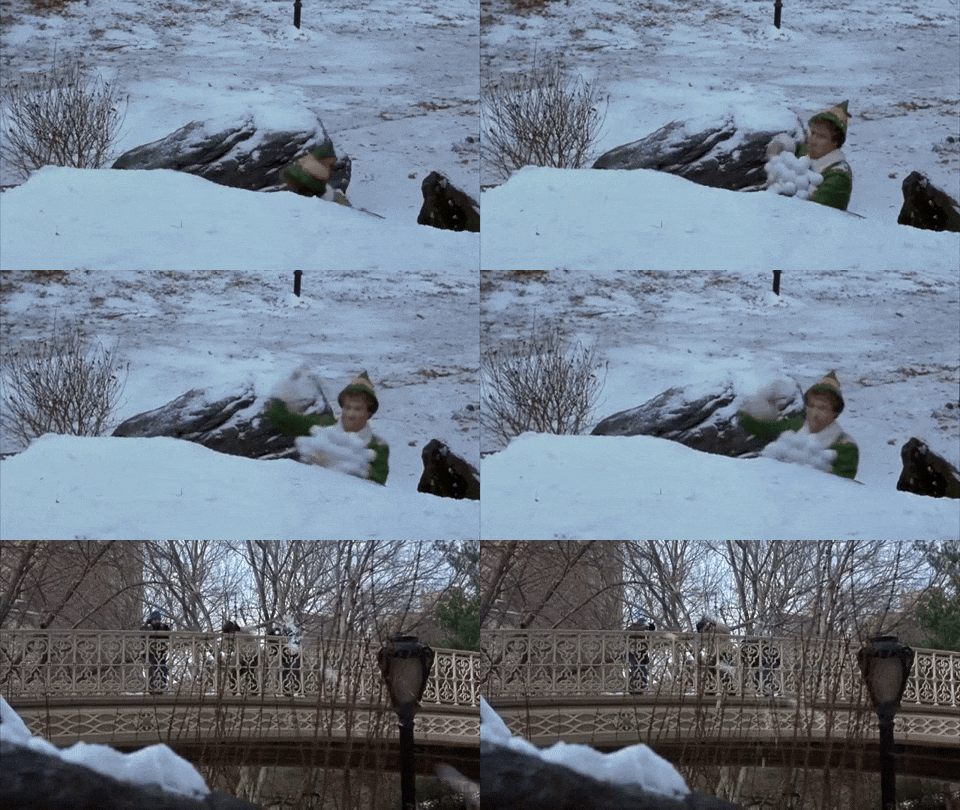
will ferrell snow GIF

The Experiment

Part 1: Projectile Motion of the snowball


The overall motion of the snowball was right and downwards. This is due to the forces that were acting on the ball while it was in the air. The first, gravity caused it to move downwards. The second, air resistance, caused the ball to slow down in the x direction. 

Velocity VS Time of the Snowball


Velocity of Snowball before collision with target:
10.127 m/s

Part 2: Collision With Target


Calculating Final Velocities of Snowball and Target
Mass of Snowball: .028kg
Mass of Target: .168 kg
Initial Velocity: 10.127 m/s
Change in height of Frisbee = .21844 m

Velocity of Frisbee after collision
1/2 m v^2 = mgh
1/2 * v^2 = 9.8 * .21844
Final Velocity of Frisbee = 2.06916 m/s

m1 * v1i + m2*v2i  = m1 * v1f + m2*v2f
.028 * 10.127 + 0 = .028 * v1f + .168 * 2.06916

.283556 = .028 * v1f + .347619

v1f = -.06406/.028
Final Velocity of Snowball = -2.28796 m/s

Sources


Ice and Friction


The Force of Friction of Ice
When the lake behind my house froze over me and my friend Matt decided to do some pond skating. First we had to test out the ice to make sure it was frozen thick enough. While I was out on the ice I decided to try doing some jumping jacks while keeping my feet on the ground. 


In order for these "sliding jacks" to be possible there needed to be a force of friction between the soles of my shoes and the ice of the lake. I decided to solve for the force of friction present between my shoes and the ice as my feet slid across the ice. In order to do this I had to split the motion up into four separate parts. The first part is the acceleration of my feet moving outwards. The second is the deceleration of my feet moving outwards as they come to a stop. The third piece of motion is the acceleration of my feet moving inwards and the last is the deceleration as my feet come to a stop in the center. The first thing I did was create force diagrams for each of the points of motion with the "sliding jack".


After this I used logger pro to analyze the video. In order to do this I assumed a few things. The first is that the distance between my legs when they are at the furthest point away from each other is 1 m. I also assumed that the motion and force of each foot was equal to the other. I then uploaded the data into a google sheets document and calculated the acceleration, time, change in velocity, change in position, and final velocity for each of the four pieces of motion. 

The graph of X Velocity vs. Time:


Using the data above in google sheets I then created graphs for each of the four parts of the motion shown. I calculated the slope for each graph and used that for the acceleration value in my calculations.


Once I calculated all of these values I began creating force equations for each direction. In order to solve for both the force of my foot as well as the force of friction I needed to create a system of equations. I used energy in order to create this system.

Important equations:
∑F = mass•Acceleration
Initial Mechanical Energy + Work of outside forces = Final Mechanical Energy
KE = 1/2massvelocity^2

Part 1: Foot acceleration while moving outwards
Mass = 56.25 Kg
Average Acceleration = .0812
Time = .37
ΔV = 1.108
ΔX = .156
V = 1.189

∑Fy = FN - Fg = N - Fg = 0
        N = 275.906 N
∑Fx = Ffoot - friction = (m/2)a
        = foot - friction = 2.28375 N

Ei + Wf = Ef
0 + (foot+friction)(distance) = .5*(m/2)v^2
.156forces = 19.88045
Outside forces applied = 127.439 N

F-f = 2.28
F+f = 127.439

Force of the foot = 64.8594 N
Force of friction = -62.5794 N 
Coefficient of Friction = .2268


Part 2: Foot deceleration while moving outwards
Mass = 56.25 Kg
Average Acceleration = -.155
Time = .33
ΔV = -1.865
ΔX = .363
V = 0.182

∑Fy = FN - Fg = N - Fg = 0
        N = 275.906 N
∑Fx = Ffoot - friction = (m/2)a
        = foot - friction = -4.35938 N

Ei + Wf = Ef
0 + (foot+friction)(distance) = .5*(m/2)v^2
.363forces = .45805
Outside forces applied =  N

F-f = -4.35938 N
F+f = .465806

Force of the foot = -6.76726N
Force of friction = -2.4079 N
Coefficient of Friction = .008


Part 3: Foot accelerating while moving inwards
Mass = 56.25 Kg
Average Acceleration = -.153
Time = .2
ΔV = -.9326
ΔX = -.144
V = -1.121

∑Fy = FN - Fg = N - Fg = 0
        N = 275.906 N
∑Fx = Ffoot - friction = (m/2)a
        = foot - friction = -4.30313 N

Ei + Wf = Ef
0 + (foot+friction)(distance) = .5*(m/2)v^2
.2forces = 17.6715
Outside forces applied =  88.3576N

F-f =  -4.30313 N
F+f = 88.3576 N

Force of the foot = -46.33034765625 N
Force of friction = 42.02722265625 N
Coefficient of Friction = .168


Part 4: Foot decelerating while moving inwards

Mass = 56.25 Kg
Average Acceleration = .165
Time = .2
ΔV = 1.057
ΔX = -.133
V = -0.064

∑Fy = FN - Fg = N - Fg = 0
        N = 275.906 N
∑Fx = Ffoot - friction = (m/2)a
        = foot - friction = 4.64063 N

Ei + Wf = Ef
0 + (foot+friction)(distance) = .5*(m/2)v^2
.2forces = 0.0567
Outside forces applied =  .288N

F-f =  4.64063 N
F+f = .288 N

Force of the foot = 2.46431 N
Force of friction = −2.17631 N
Coefficient of Friction = .0079


Tennis bouncing

 To celebrate Chrismas, Santa(Yufan) and I have a wonderful outdoor experiment about how many energy does the object lost during the collision.

On account of both Yufan and I fascinate tennis, we two decided to use the tennis as our object in the experiment.

material: a normal sized tennis ball(58.5g), wall, ruler, phone, timer.

First, we measure the 1 meter away from the wall as our start line where we push the tennis ball.

Then, we record the video and push the ball.

After all of these actions, we used logger pro to calculate the time the ball need to collide the wall and the time it went back to start line after the collision.

Data:
time spent before the collision: 2.15s.
time spent after the collision:4.3s.

use the equation V= d/t
Vi:1/2.15=0.465m/s
Vf:1/4.1=0.243m/s

the energy = 0.5*m*v^2
Ei=0.0063J
Ef=0.00173J

The energy lost: 0.00457J.
Sant and me.


A N"ICE" Way to Find the Coefficient of Friction

There is no better activity to do on a cold winter’s day than ice skating!  As we know, ice is good
for skating because it has a low kinetic friction coefficient between it and other materials,
making it slippery.  But, just how low is this number?  I decided to use a hockey puck to figure
this out!


As you can see in the video, the hockey puck is hit by the stick with some force, which causes it
to slide on the ice until it hits a second hockey puck.  To determine the final velocities of both the
hockey stick and puck just before it hits the second puck, as well as the distance the puck
traveled and the time that the hockey stick traveled, I used Logger Pro.


Once I had my data, I used kinematics to solve for the accelerations of the hockey puck
and stick.

Hockey Puck
Hockey Stick
x = 0.5836 m
vi = 0 m/s
vf = 0.1366 m/s
a = ?
t = 1.5 sec
vi = 0 m/s
vf = 0.119 m/s
a = ?
vi2 = vf2 + 2ax
0.13662 = 02 +2a(0.5836)
a = 0.016 m/s2
vf = vi + at
0.119 = 0 + 1.5a
a = 0.0793 m/s2

Then I drew a free body diagram for the hockey puck.
ΣFy = N - Fg = 0
ΣFx = Fstick - fk = ma

In order to find the force of the stick and the force of the friction, I used the masses of the
hockey puck and stick.  

Hockey Puck
Hockey Stick
Mass: 0.156 kg
Mass: 0.538 kg

Fstick = 0.538 * 0.0793 = 0.0427 N
Fstick - fk = ma
0.0427 - fk = 0.156 * 0.016
fk = 0.0402 N

Finally, I used the Normal force to find the coefficient of kinetic friction between the ice and
rubber.

N - Fg = 0
N - 9.8 * 0.156= 0
N = 1.5288
fk = N
0.0402 = 1.5288
= 0.026

Thus, the coefficient of kinetic friction between ice and the particular type of rubber of which
the hockey puck was created is 0.026.

Special thanks to Matthew Poirier, Shaila Murthy, Victoria Hennemann, and Kathryn Grupp for helping with the video!